
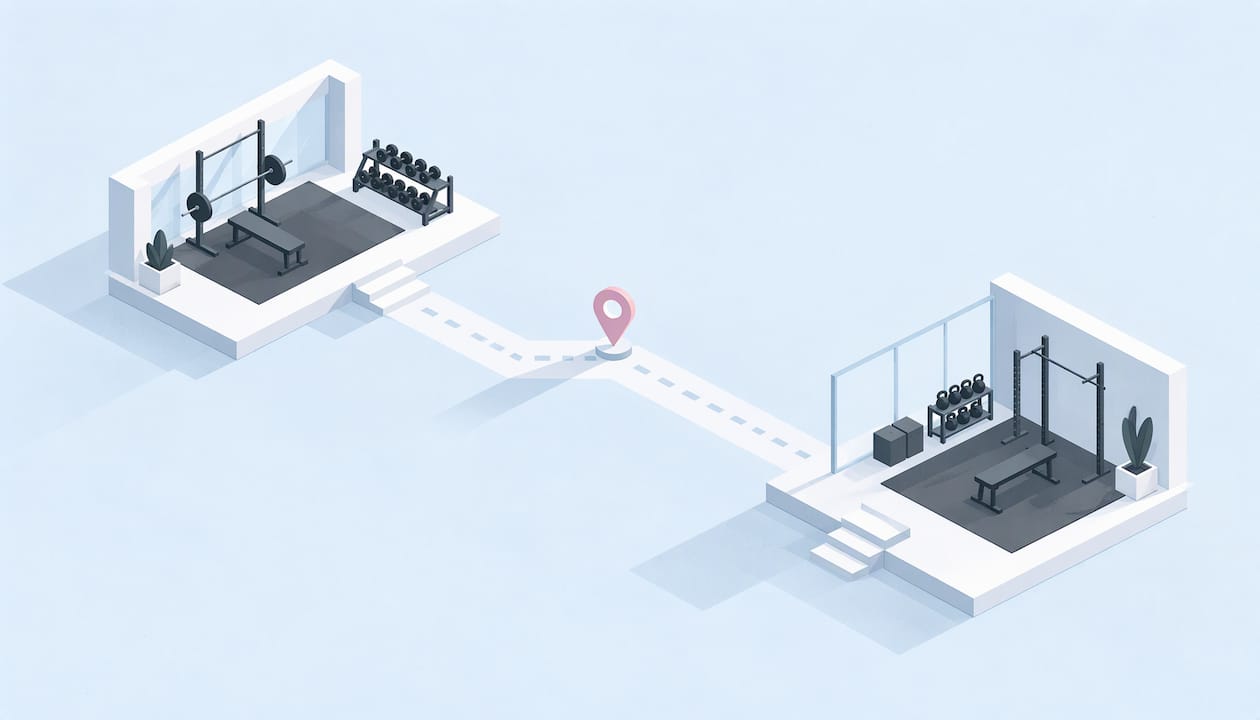
The fastest way to find a gym while traveling is to search by your hotel's location with visitor terms like "day pass" or "guest pass," confirm the visitor rules with the gym, and log the session so your training carries on. Lightweight is built for exactly this: it keeps a separate record for each gym you train at, includes a gym search directory with day-pass and amenity info, and lets you log sessions offline when hotel Wi-Fi or airport signal fails.
The hard part is rarely locating a building. It is learning whether that building will let a visitor in, at what hours, for how much, and with the equipment your program needs. This guide walks through that in order.
TL;DR
- Search with the city plus "day pass," "drop-in" or "guest pass," then check the gym's own page, because a map listing rarely says whether non-members can train.
- Ask about price, staffed hours, ID, waiver and equipment before you go. Staffed hours often differ from opening hours.
- For stays of more than a few days, compare a day pass, a week pass and a free trial. Many trials exclude short-term visitors.
- Pick a backup gym and expect different plates, dumbbell jumps and machines than at home.
- Log every session per gym, so the next visit to any gym starts from real numbers.
Table of Contents
- Start with the map, then the gym's own page
- The ways a visitor can get through the door
- What to check before you go
- When you are in a country with different habits
- If you cannot get into a gym at all
- Adapting to an unfamiliar gym
- Keeping your training record across gyms
- Training with friends on the road
- Make the trip count with Gym Passport
- FAQ
- Sources
Start with the map, then the gym's own page
Center a map on where you are staying, not on the city center. A gym 40 minutes away from your hotel is a gym you will skip on day two. Search "gym" and "fitness," and in non-English countries add the local word too. In Italy, for example, searching for palestra surfaces independents that English searches miss.
Then do the step most travelers skip: open the gym's own website. Map listings show hours and photos but often say nothing about visitors. Search the gym name plus "day pass" and the city, or look for a "visitors," "guest" or "pricing" page. If there is no clear answer, an email or a short call a day or two ahead settles it.
A few search phrases that work well:
- "[city] gym day pass"
- "[city] drop-in gym"
- "[neighborhood] gym guest pass"
- "[city] 24 hour gym visitor"
If you want the directory step handled in one place, Lightweight's gym search lets you look up gyms and see day-pass and amenity information, with filters for how well a gym fits your routine. Lightweight's London pages show how this looks for one city, including day pass gyms in London and 24-hour gyms in London.
The ways a visitor can get through the door
There are four common routes. Which one works depends mostly on the country and the chain.
Day pass
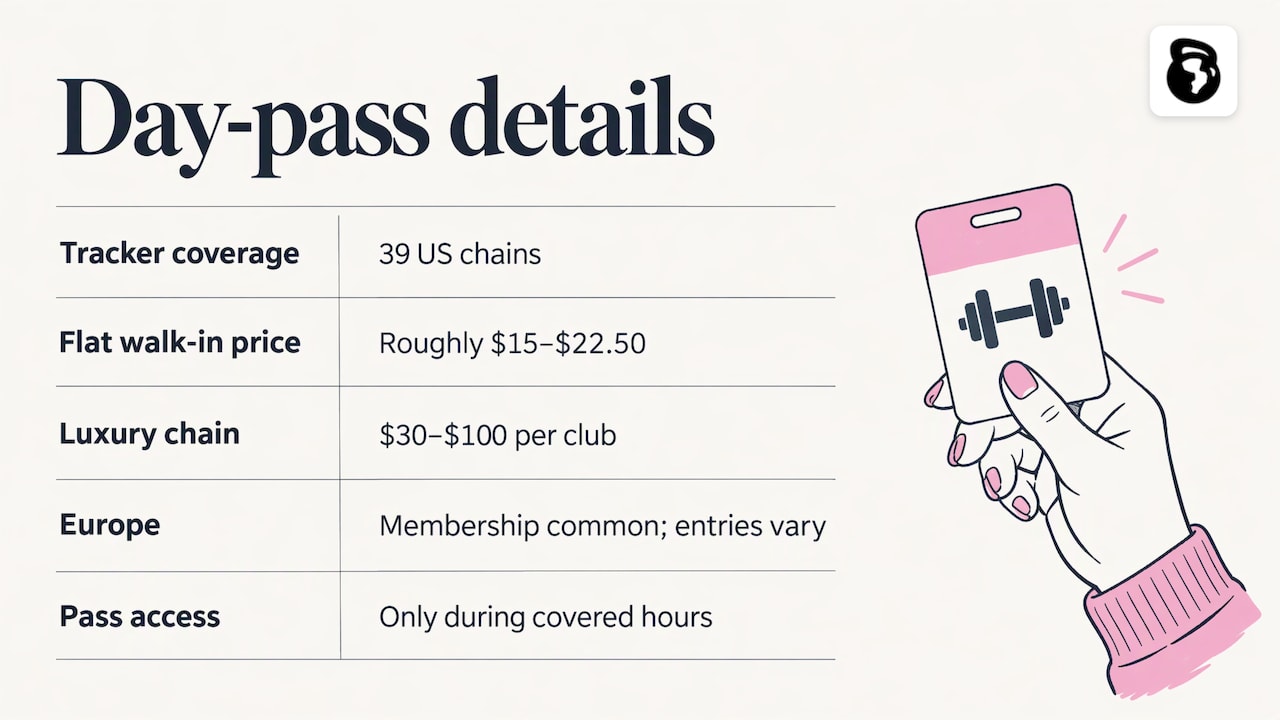
You pay for a single visit at the desk, in an app or on the website. Expect to show photo ID and sign a waiver, and expect to train only during the hours the pass covers. In the United States, day passes are easier to find at independent gyms and some franchise locations than at the big national chains, where a published walk-in price is the exception. One US day-pass tracker that covers 39 chains found that only a couple publish a flat walk-in price, roughly $15 to $22.50, while a luxury chain publishes a per-club range of $30 to $100.
Outside the US, practice varies gym by gym. In Europe, many places want a membership, and others sell single entries at the front desk. Pay attention to what the individual gym says, not to what the chain does elsewhere.
Guest pass through a member
If a friend or relative at your destination belongs to a gym, a guest pass is often the cheapest route in. Many chains give members a limited number of guest visits, sometimes only when the member comes along. Ask them to check the rules for their specific location.
Free trial
A free trial of a few days looks perfect for a short trip, and sometimes it is. But trials often require a local address, a sales conversation, or a minimum age of 18. In Thailand, for example, local reports note that some advertised free trials are limited to residents and long-term visa holders, not holiday visitors. Read the eligibility line before you plan around one.
Week or multi-visit pass
For a longer stay, a week pass or a ten-visit pass can beat paying per day. Do the arithmetic before you buy: if three day passes cost more than one seven-day pass, the week pass wins, but only if it starts when you want it to and is valid at the branch you will use. In some places even this is cheap. One Singapore example puts a gym's day rate at S$25 against S$60 for a week, worth it from the third visit.
What do these cost? Prices swing widely by country and city, so treat any figure as a snapshot and confirm it on the gym's page. The pattern holds, though: a one-day visit is usually priced to nudge you toward something longer, and pay-as-you-go rarely beats a membership if you will be around for weeks.
What to check before you go
A two-minute check saves a wasted trip and a wasted fee. Run through this list for each gym.
- Price and what it includes. Is the lifting area covered, or just cardio? Are towels and lockers extra?
- Staffed hours versus opening hours. A 24-hour gym does not always sell passes around the clock. Many admit visitors only while reception is staffed, which can rule out a 5 a.m. session.
- Visitor requirements. Passport or photo ID, minimum age, a local phone number, advance booking, an app download, an access-card deposit, or a member who must accompany you.
- The exact branch. Franchise locations of the same chain can set different prices and policies.
- Facilities you need. Showers, lockers, Wi-Fi, towel rental, changing rooms, a pool or sauna.
- Equipment you need. Racks, a platform, whether chalk is allowed, whether you can drop a deadlift, and whether plates and bars are in kilos or pounds.
The National Center on Health, Physical Activity and Disability adds a few more tips in its guidance on choosing a fitness center: pick one that is easy to reach, with hours that match your schedule, and visit at the time you will actually train, trying a weekday off-peak slot such as 9 to 11 a.m. or 2 to 4 p.m. to see the place at its quietest. It also suggests asking about a temporary pass for a small daily fee, or a member's guest pass, and trying more than one facility.
If you are training for a specific lift, the equipment questions matter most. A gym with two dumbbell pairs topping out at 40 pounds will not serve a heavy bench day. Pick a backup gym in case your first choice turns out to have a surprise.
When you are in a country with different habits
A few examples show why local knowledge matters more than a global rule.
- Thailand. Visitor passes at some 24-hour chains cover only staffed hours, so a pass at a gym called 24-hour may not let you train at 3 a.m. Local-language searches like ฟิตเนส รายวัน (daily-access fitness) turn up smaller gyms.
- Vietnam. Day passes are typically sold at the front desk, often for cash. Many gyms open at 4 or 5 a.m. and some close midday, so check the hours before the trip across town.
- Italy. Registration with ID is standard, and a medical certificate is usually not needed for a single day but may be asked for multi-day or monthly access.
- Fitness chains abroad. There is no single global pass system for a chain. In some countries you buy a dated day or week ticket, in others prepaid credits, and in some you must ask the club directly.
The lesson is the same everywhere: the gym's own page or a quick message beats an assumption.
If you cannot get into a gym at all
Sometimes there is simply no suitable gym nearby, or your schedule does not fit. You still have good options. The US Centers for Disease Control and Prevention's guide to staying active away from home suggests a hotel with a fitness center or pool, a packed resistance band, a rented bike, or no-equipment activity such as walking, stair climbing and wall push-ups. It also recommends a two-minute movement break for every 30 minutes of car travel.
For strength, the federal Physical Activity Guidelines for Americans call for muscle-strengthening activity involving all major muscle groups on two or more days a week. That is a useful floor for a trip: two decent full-body sessions in a week away keep you on track even if the rest of the week is sightseeing.
A simple template for a hotel gym or a basic visitor gym, about 20 minutes:
- One push (dumbbell press or push-up)
- One squat or lunge variation
- One pull (row or lat pulldown)
- One core exercise
- One carry or arm exercise
Do two to three sets of each. If dumbbells top out light, work in higher rep ranges; if they go heavier, stay lower.
If your trip is a hiking or outdoor one, plan the lifting around the miles and give your skin a thought too: this guide to post-hike skin recovery covers what to do after long days outdoors. And remember that after travel days and big hikes, muscles need time, so check recovery times between workouts before stacking hard sessions back to back.
If you have a medical condition or an injury, talk to your doctor before changing your routine for a trip.
Adapting to an unfamiliar gym
The first session in a new gym is slower. Budget an extra 15 to 30 minutes to find where things are and to work out substitutes. Some things to expect:
- Different equipment. No kettlebells? Use a dumbbell. A cable stack set too high? Swap in a row or pulldown variation.
- Different plates. Plates abroad are sometimes smaller in diameter than standard Olympic plates, which lowers the bar's starting height on deadlifts. Stack mats or plates under the bar or switch to a rack pull rather than rounding your back to reach.
- Different jumps. Dumbbell weights may rise in larger steps, such as 5, 10, then 15 kg.
- Different units. Kilos versus pounds is the classic error. Write down what you actually lifted in the unit on the plate.
Pack the small things that make any gym workable: your belt, straps, sleeves or a resistance band.
Keeping your training record across gyms
Here is the problem most trackers do not solve. Your bench press at home and the bench press at a gym in Lisbon are not the same setup. Different machines, different plates, different cable ratios. A single history that blends them tells you very little, and a program that assumes your home numbers will have you either under-lifting or overreaching.
We built Lightweight around that. You log workouts per gym, with notes on equipment setups and machine records for each facility, and you can keep gym-specific versions of a routine, so the version for a cramped hotel gym is not the one for your home gym. Sessions can be logged offline, which helps in basements and on flights, and you can export or import your data as CSV.
If you want to see how that approach compares with general-purpose loggers, read about a gym-aware workout tracker or the overview of workout trackers for weightlifting. If you are bringing a favorite lift on the road, our guides to the barbell bench press and leverage rows cover form and how to track progress on them.
Training with friends on the road
Traveling with a training partner, or meeting a friend in another city, adds a coordination problem: you both need access, the same hours and a plan. Practical steps:
- Choose one gym that works for both of you and confirm visitor rules for two people. Some require each visitor to buy a pass and sign a waiver.
- Agree a time during staffed hours and an off-peak slot so you are not waiting on equipment.
- Decide on a shared routine before you arrive.
In Lightweight, you can join a friend's routine live and train together in real time, with leaderboards and status points to keep it competitive. It is a simple way to make a trip workout feel like one you would have done together at home.
Make the trip count with Gym Passport
Every gym you visit is a record worth keeping. Gym Passport in Lightweight builds a log of every gym you have trained at, anywhere in the world, with status points and permanent ranks as you add locations and sessions. The free plan covers the standard features, including four routines, full workout history and charts, and ChatGPT and Claude assistants for analysis and routine creation. Pro unlocks more, such as custom statistics, extended gym-specific matching and routine scheduling. See the Free plan and Pro details or start at getlightweight.com.

Before a trip, set up a travel version of your routine, note the gyms you plan to visit, and log from your first session. By the time you are home, you will have a clear picture of how each gym compared.
FAQ
How do I find a gym when traveling?
Search for gyms around your hotel using terms like "day pass" or "guest pass" plus the city name. Then open each gym's own website or contact it to confirm visitor rules, price and hours, since map listings often leave those out. Pick a backup in case the first choice does not work out.
How much does a gym day pass cost?
It varies widely by country, city and chain. In the US, a day-pass tracker covering 39 chains found flat walk-in prices of roughly $15 to $22.50 at the few chains that publish one, with many chains publishing no figure at all. Confirm the price on the specific gym's page before you go.
Can I use my home gym membership while traveling?
Sometimes, if your chain has locations at your destination and your plan covers them, but policies differ by chain and by plan. Check your membership terms, and ask whether your plan includes guest or multi-location access. Franchise branches can set their own rules.
How often should I work out on a trip?
For general health, US federal guidance recommends muscle-strengthening activity on two or more days a week. On a short trip, two full-body sessions plus regular walking is a realistic way to stay on that track.
Sources
- Gym Day Pass Checker, prices and rules (United States)
- Choosing a Fitness Center, National Center on Health, Physical Activity and Disability
- Stay Active Away from Home, CDC participant guide
- Physical Activity Guidelines for Americans, 2nd edition
- Hua Hin gym day passes: short-stay access checks
- Singapore gym day passes: prices and where to train