
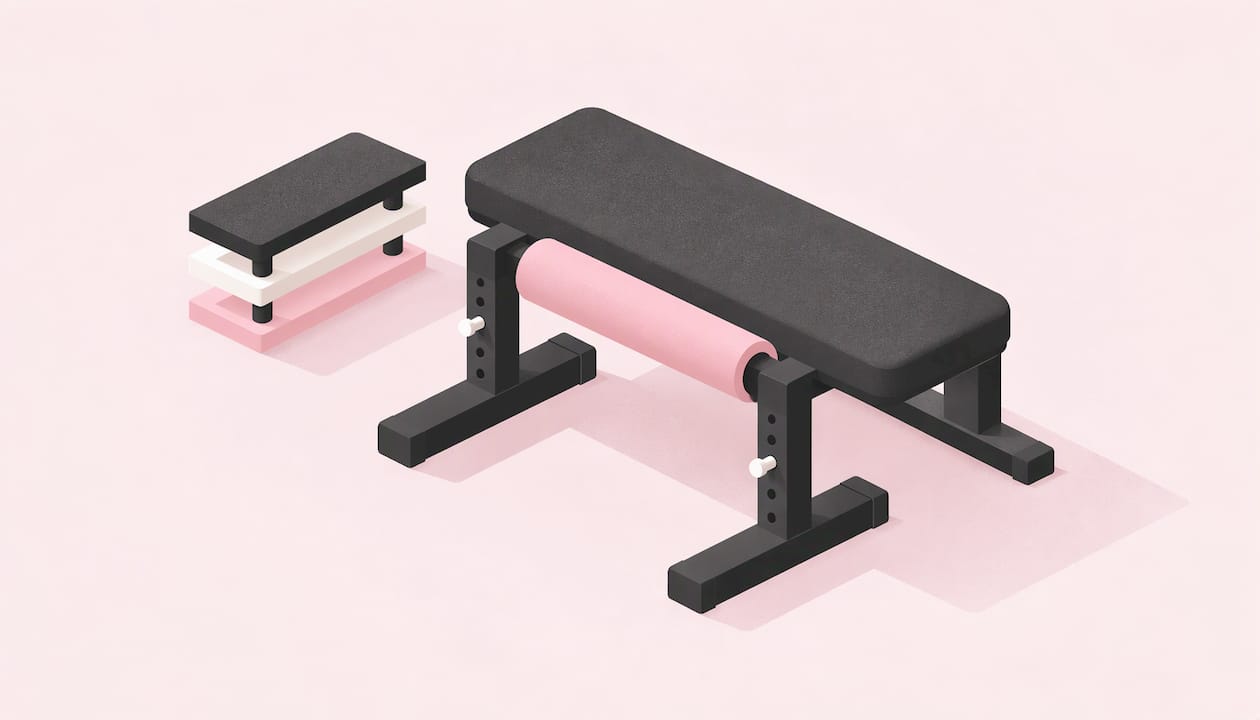
A good hip thrust bench is low, wide, heavy and padded. In practice that means a top surface around 16 to 17 inches high, a pad at least 12 inches wide, and enough weight or wall support that it doesn't slide when you drive up. Every gym and every home setup has a different bench, though, so the same weight can feel very different from one place to the next. If you train in more than one gym, the smartest habit is to log which bench you used and how you set it up, which is what we built Lightweight to do.
TL;DR
- A dedicated hip thrust bench is a low, wide, stable bench built for barbell hip thrusts. A standard flat bench works if it's anchored and not too tall.
- Aim for roughly 16 to 17 inches of height, a pad 12 inches or wider, and a base that won't creep. Bench mass matters more than adjustability.
- Set the bench against a wall or rack, put the bench edge under your shoulder blades, keep your shins vertical at the top, and keep your eyes forward, not on the ceiling.
- No bench? A couch, a sturdy step or a floor glute bridge will do the job, with the right precautions.
- Log the bench height, pad and foot position for each gym so your numbers are comparable from one location to the next.
Table of Contents
- What a hip thrust bench is, and how it differs from a regular bench
- How to choose a hip thrust bench
- How to set up the bench and do the hip thrust
- Lower back discomfort on hip thrusts
- No hip thrust bench? Your options
- Variations that use the same bench
- Why the bench matters when you train at more than one gym
- Track your hip thrust setup in Lightweight
- FAQ
- Sources
What a hip thrust bench is, and how it differs from a regular bench
The hip thrust is a glute exercise: your upper back rests on a bench, a barbell sits across your hips, and you drive your hips up until your body forms a straight line from shoulders to knees. A hip thrust bench is the equipment made for it. One UK equipment retailer describes it as a low-profile bench designed for barbell hip thrusts and glute bridges, typically lower, wider and more stable than a standard weight bench, with many lifters finding about knee height comfortable.
There are really three things you'll meet:
- Dedicated hip thrust bench: a padded box or low bench, often around 16 inches high, made to stay planted under a loaded bar.
- Glute bench: a lower, longer variant. One manufacturer's comparison lists a 15.75-inch hip thrust bench and an 11.81-inch glute bench, with the taller one suited to average-to-tall lifters and the lower one to shorter lifters, beginners, bridges and step-ups.
- Standard flat bench: the one in every commercial gym. Most sit about 17 to 17.5 inches off the ground, against about 16 inches for a dedicated hip thruster. That is usable, and many people thrust off one every week.
The difference is small on paper and large in practice. A bench that's an inch too tall leaves your hips short of full extension. One that's an inch too low makes you thrust from a deeper, awkward start.
How to choose a hip thrust bench
Height
Your hips need to reach full extension with your shins roughly vertical. One bench review recommends 16 to 17 inches for most adult lifters and warns that a 19-inch bench leaves the hips short of lockout. Another setup guide puts the working range for most lifters at 14 to 16 inches when the bench is anchored. The overlap is the practical answer: somewhere between 14 and 17 inches, with shorter lifters toward the low end and tall lifters toward the high end.

Pad width and thickness
A narrow pad can roll under your shoulder blades. A home-gym buying guide says a pad of 12 inches or more spreads the load better than a 10 to 12 inch pad, which can pinch the shoulder blades, and that thick, firm padding matters more than adjustability for stability. A wide pad is not a flaw here. One review makes the point that a 14-inch pad is an advantage for this lift, even though it is wider than what a powerlifting bench rule allows.
Weight and stability
At the top of a heavy rep, part of your drive pushes horizontally. The bench resists that only with its own weight and the friction of its feet. The same reviewer explains that an 18 lb folding bench creeps backward on smooth flooring while a 76 lb bench stays planted. If you can't get a heavy bench, you can fix the problem with a wall or a rack, as covered below.
Load rating
Load capacity must cover your body weight plus the bar. Consumer benches are commonly rated somewhere around 500 pounds, and heavy commercial benches go much higher. Leave yourself a wide margin.
Quick buying checklist
| What to check | Good target |
|---|---|
| Top surface height | About 14 to 17 inches, matched to your height |
| Pad width | 12 inches or more |
| Padding | Thick and firm, not squishy |
| Weight or anchoring | Heavy base, or placed against a wall or rack |
| Floor grip | Non-slip feet, or a rubber mat under the bench |
How to set up the bench and do the hip thrust
- Anchor the bench. Set the long end against a solid surface such as a wall so it can't move. A squat rack upright also works, and one coaching guide recommends an immovable rack or wall. Check this first. A bench that slides mid-set is how people get hurt.
- Sit on the floor in front of it. The bench edge should land just under your shoulder blades, not at your lower back and not up by your neck.
- Roll the bar over your hips. Center a pad or sponge on the bar to protect both hip bones. A towel can slip and is less secure, according to the same guide.
- Plant your feet. Foot position decides which muscles do the work. The shins should be vertical at the top. Feet too close to your glutes shift emphasis to the quads, and feet too far forward shift it to the hamstrings and reduce glute drive.
- Drive up. Press until your hips line up with your shoulders and knees. Keep your core tight and your chin slightly tucked.
- Lower under control until your hips are a few inches off the floor, then repeat. This is the standard cue from the same exercise guide.
If you have a back or hip problem, speak with a healthcare provider before adding the lift.
Where setups go wrong
- The bench is too tall. Your hips stop short of the top and the set turns into a half rep. Use a lower surface or put a mat or plate under your feet so you sit lower relative to the bench.
- The bar is rolling. Use a thick pad and keep the bar over your hip crease.
- The bench drifts. Put it against a wall or rack, and put a rubber mat under the legs on slick floors.
Lower back discomfort on hip thrusts
The most common mistake is looking at the ceiling. One coaching source identifies looking up as the usual cause of lower back pain on this lift, because tipping your head back pulls your lower back into hyperextension. The fix it gives is simple: eyes forward or slightly down, chin tucked, ribs down, and a slight posterior pelvic tilt (tucking your tailbone under) at lockout.
So the cues are: stack ribs over pelvis, finish the rep with your glutes rather than by arching, and don't load so heavily that you lose the position. If pain in your lower back persists, stop the lift and see a doctor or physical therapist. If your knees or hips make loaded training hard in general, this guide to knee-friendly strength training lays out other ways to keep your lower-body work going.

No hip thrust bench? Your options
You don't need a dedicated bench to train the pattern. These are the substitutes that work, from easiest to most advanced:
- Floor glute bridge. Lie on the floor with knees bent and drive your hips up. The range of motion is shorter, which also means you can often load it heavier with a barbell or dumbbell.
- Couch or sturdy sofa edge. Rest your upper back on the edge, with the couch pushed against a wall. Most couches are taller than ideal, so expect a shorter lockout than on a proper bench.
- Step or aerobic platform. One coaching guide says cardio steppers can substitute if set against a wall so they don't topple under load.
- Gym flat bench against a rack. This is the usual commercial gym solution and fully effective.
Whatever you choose, the rules don't change: it has to be immovable, at a height that lets your hips reach the top, and your upper back needs a stable edge to rest on.
Variations that use the same bench
Two variations share the same setup. In the B-stance, also called the kickstand version, one leg extends forward until its heel lines up with the planted foot's toes. The kickstand leg contributes about 30% of the force, and the closer leg does most of the work. It is often used as a progression toward the single-leg hip thrust, or when balancing a barbell is hard. In the single-leg version, the other leg comes fully off the floor.
Expect your working weight to drop sharply when you switch. That's normal, and it's a good reason to keep each variation as its own entry in your log.
Why the bench matters when you train at more than one gym
Here's the problem for anyone who trains in several places: no two gyms have the same bench. One has a 17-inch flat bench by the squat rack. Another has a purpose-built hip thruster. A third has a folding bench you need to jam against a wall. Your 225-pound set on one might be a 185-pound set on another, simply because of height, pad and stability, not because you got weaker.
If your log only says "hip thrust, 225 lb," you lose the context that explains the number. Good notes for each gym include:
- Which bench or station you used, and its approximate height
- Whether you braced it against a rack or wall, and which one
- Foot position (for example, a measured distance from the bench)
- Which pad or bar sponge you used
- The weight and reps
Track your hip thrust setup in Lightweight
Lightweight is a workout tracking app for people who train across multiple gyms. You log workouts per gym, keep equipment setup notes and machine records for each location, and run gym-specific versions of the same routine. Your hip thrust at the garage gym and your hip thrust at the downtown gym stay separate, each with its own bench note, so you compare like with like.

If you're away from home, the gym search directory helps you find a place to train and see day-pass and amenity info, and offline session logging means a basement gym with no signal doesn't break your log. The Free plan covers the basics, and Pro adds custom statistics and routine scheduling. You can see exactly what's in each on the Lightweight plans page, or get the app itself. If you're choosing between logging options, our guide to workout trackers for weightlifting walks through what to look for.
Once your bench notes are in place, the same approach works for other machine-dependent lifts. We cover it for leverage rows and the seated calf raise machine.
FAQ
What height should a hip thrust bench be?
Most lifters do best with about 16 to 17 inches, with a working range of 14 to 17 inches depending on leg length. Shorter lifters generally do better toward the low end. A bench around 19 inches tends to leave the hips short of lockout.
Can I use a regular flat bench for hip thrusts?
Yes. Most gym flat benches sit about 17 to 17.5 inches high, which works for many people if the bench is braced against a wall or squat rack. Make sure it can't slide, and use a pad on the bar.
Can you do hip thrusts without a bench?
Yes. A floor glute bridge trains the same movement with a shorter range of motion. A sturdy couch pushed against a wall or a stable step also works. Whatever you use must not move under load and should support your upper back.
Can hip thrusts cause lower back pain?
They can when the setup or position is off, most commonly when you look at the ceiling and arch your lower back at the top. Keep your eyes forward, chin tucked and ribs down, and finish with your glutes. If pain continues, stop and see a doctor or physical therapist.
How do I compare hip thrust numbers across different gyms?
Record the bench height, pad, anchoring and foot position along with the weight, and keep a separate log for each gym. Then a change in the number reflects your strength, not a different bench.
Sources
- Hip Thrust Benches, Mirafit
- Hip Thrust Bench vs Glute Bench, GXMMAT
- Best Bench for Hip Thrusts, Knurl Knock
- Weight Bench for Hip Thrusts, AffordableHomeGym
- How to Do a Hip Thrust, Verywell Fit
- The Foolproof Guide To Setting Up Barbell Hip Thrusts, Fitman Performance
- Barbell Hip Thrust: Form, Muscles Worked, and Programming, VitalEdgeFit
- How To Do B-Stance Hip Thrusts, Onnit
- 7 Best Hip Thrust Variations, Inspire US Foundation
- Knee-Friendly Strength Training: A Practical Guide