
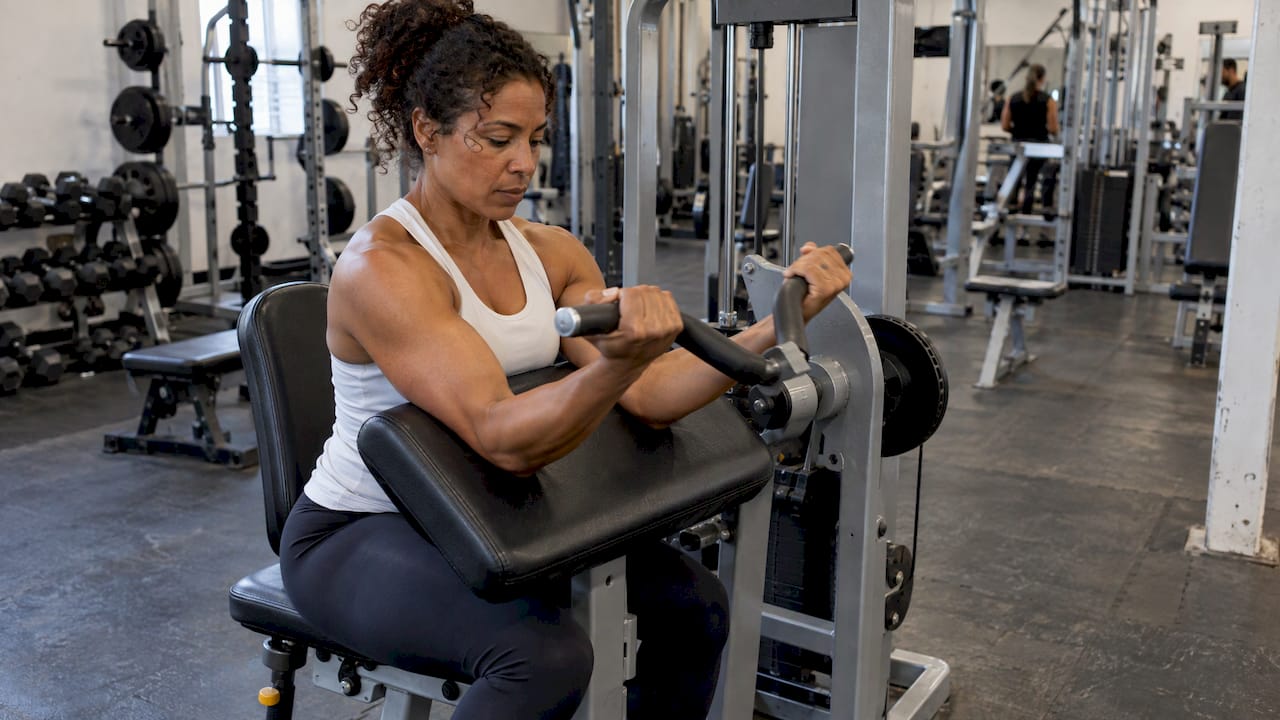
The preacher curl machine locks your upper arms against an angled pad so your biceps do the work and momentum does not. Set the seat so your armpits sit snug at the top of the pad, curl slowly, and stop just short of a locked-out elbow at the bottom. The harder part is progress: the same 60 lbs feels different on every brand of machine, so your numbers only mean something if you record them for each gym and each setup. That is where a per-gym log beats a note in your head, and it is what Lightweight is built for.
TL;DR
- The machine preacher curl isolates the biceps, with help from the brachialis and brachioradialis, by fixing your upper arms to a pad.
- Seat height decides everything: armpits snug at the pad's top edge, upper arms flat, elbows lined up with the machine's pivot.
- Aim for about 3 sets of 10 to 12 controlled reps, and add load only after you hit the top of your rep range on every set.
- A machine's weight number is not comparable between brands or gyms, so log the machine and seat setting along with the load.
- If you train at more than one gym, keep a separate record for each machine so your progress stays honest.
Table of Contents
- What the preacher curl machine works
- How to set up the machine
- How to do the rep
- How much weight should you use?
- Why your preacher curl numbers don't travel
- Train arms with friends and compare
- Put it into practice
- If the machine is taken or missing
- FAQ
- Sources
What the preacher curl machine works
The machine preacher curl is a seated elbow-flexion exercise. Your upper arms rest on an angled pad, you grip the handles palms up, and a guided lever carries the weight through a fixed arc. The main muscle is the biceps brachii. The brachialis, which sits underneath the biceps, and the brachioradialis, the big forearm muscle near the elbow, help out, while your forearm flexors hold the handles (Combat Fitness).
The pad is the point. With your arms pinned, you cannot swing your torso or drift your elbows forward to cheat a rep. That makes the machine a clean way to put work into the biceps without worrying about balance or a barbell's path.
Why the bottom of the rep matters
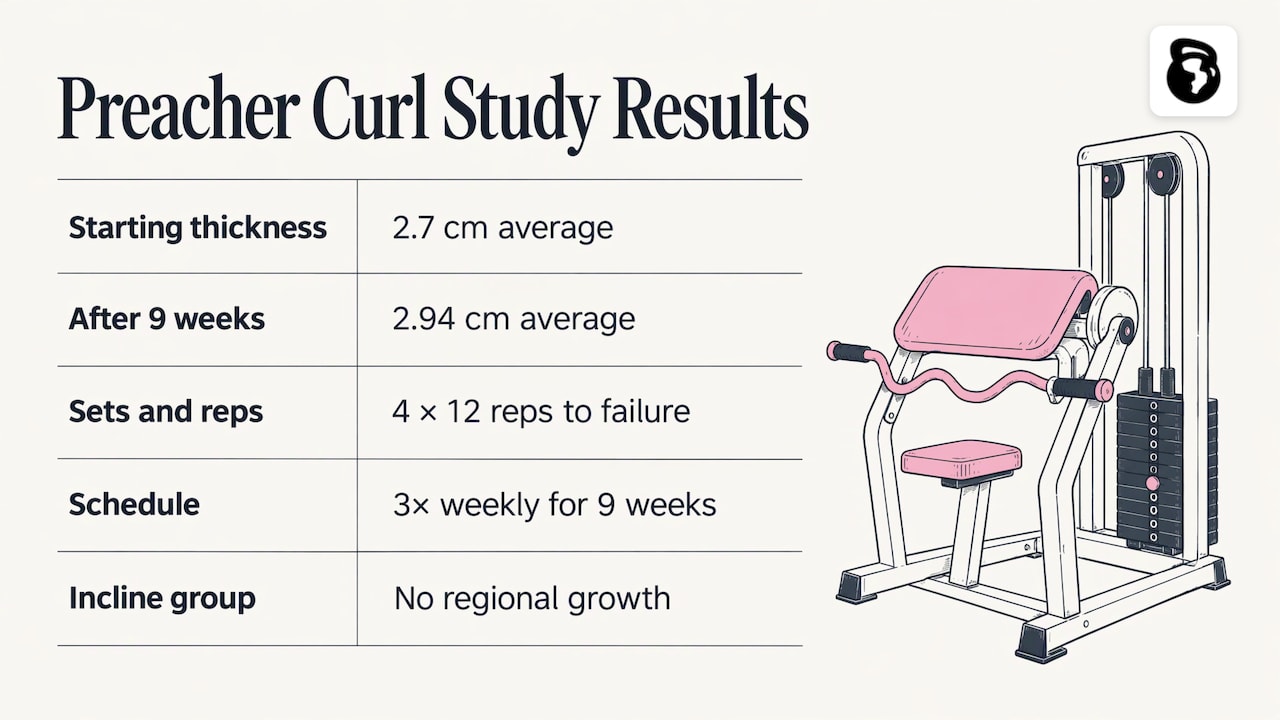
Research on preacher curls keeps coming back to the stretched position at the bottom. In a 2023 Journal of Human Kinetics study, people did 4 sets of 12 preacher curls to failure three times a week for nine weeks, and the lower part of the biceps grew significantly, with muscle thickness rising from 2.7 cm to 2.94 cm on average. The group that trained with inclined curls showed no regional growth in that trial.
A 2025 randomized trial of 63 young women compared preacher and incline curls over eight weeks, twice a week. It found different regional growth patterns and exercise-specific strength gains: preacher curls produced slightly more change in the distal (near the elbow) thickness, and incline curls slightly more in the proximal part. The practical lesson is that curl variations are not interchangeable, so a mix of them covers more of the muscle.
One detail to know about machines specifically: Men's Health fitness director Ebenezer Samuel notes that most machine preachers give less tension in the stretched position and more in the fully contracted position than free-weight versions. In other words, the machine is a good place to chase the squeeze at the top, and a good reason to control the lowering phase so you still earn the stretch.
How to set up the machine
Every brand sizes its seat and pad a little differently, which is why a quick setup routine matters more than any number on the pin.
- Set the seat height. Sit down and adjust until your chest is flush against the pad and your armpits are wedged in with little to no gap (Men's Health). Northwestern University Recreation's equipment guide gives the same instruction in plainer words: adjust the seat for comfortable upper-arm support, then set your elbows at the pivot.
- Line up your elbows. The machine's pivot point should sit beside your elbow joint. If the pivot is well above or below your elbow, the lever path will fight your arm instead of following it.
- Check your grip. Use a palms-up grip with wrists straight and in line with your forearms.
- Start light. Take one or two warm-up sets with a weight you could lift for 15 or more reps, and use that time to feel where the stretch starts.
Write down the seat position the moment you find it. Most machines have numbered seat settings or notches, and that number is the single most useful thing to remember next session.
How to do the rep
Once you are set, the movement is simple, and the details are about control.
- Grab the handles and squeeze your shoulder blades together. Drive your lower body into the floor so your hips stay planted.
- Curl slowly. As you reach the top, rotate your pinkies toward the ceiling for a stronger squeeze (Men's Health).
- Pause briefly at the top.
- Lower under control for about two to three seconds (Combat Fitness), stopping before your arms fully straighten. Keep a slight bend to hold tension on the muscle.
Because the stretched position is where the research points, treat the bottom as a feature, not a rest spot. Reach it slowly, pause for a beat, and turn around without bouncing.
Mistakes that cost you reps
- Lunging your chest forward. If your torso comes off the pad to finish a rep, the weight is too heavy or the seat is too low.
- Lifting your upper arms off the support. The pad only works when your arms stay on it.
- Locking out hard at the bottom. Forcing the elbow straight under load puts stress on the joint. Stop just short.
- Bending your wrists back. Keep them in line with the handles.
- Rushing the return. Dropping the weight wastes the lengthened-position work, and DynPerformance's technique guide lists throwing the torso, short pumping reps and bottom impact among the usual errors.
If you feel sharp pain in the elbow or the front of the shoulder, stop the set and, if it persists, see a physician or physical therapist before you keep training that movement.
How much weight should you use?
People search "is 60 lbs on a preacher curl machine good" because the number alone says almost nothing. A pin-loaded stack from one manufacturer can feel far lighter or heavier than another's because of different lever lengths, cable ratios and pad angles. Your body size and seat setting change it again. So 60 lbs is good if you can complete clean reps through a full range with your upper arms planted, and not good if you have to heave your torso to get there.
A sound rule from Men's Health: use the machine curl as a secondary exercise or finisher, doing about three sets of 10 to 12 reps, not a lift to max out. Place it after your heavier pulling work, such as rows or pull-ups.
A simple progression
A double-progression approach works well on machines:
- Pick a rep range, say 10 to 12.
- Train at one weight until you hit 12 reps on every set with clean form.
- Then move up by the smallest available step. One guide describes that as a single stack step on a pin-loaded machine or a small plate increment on a plate-loaded one.
- Expect your reps to drop back toward 10, then build up again.
Example: you do 3 sets of 12 at 50 lbs. Next session you move one pin down the stack to 55 lbs and manage 11, 10 and 9 reps. Over the next few weeks you work back to 12, 12, 12 and move again. That is steady progress without ego loading.
Why your preacher curl numbers don't travel
Here is the problem anyone who trains in more than one gym runs into. You hit 12 clean reps at 55 lbs at your home gym. On a trip, or at the second gym you use because it is closer to work, the machine is a different brand with a different seat range, and 55 lbs feels like 40 or like 70. You either guess, undertrain, or push too hard on an unfamiliar lever.
The fix is a log that treats each machine as its own thing. One tracking guide puts it plainly: a machine's number is not comparable with an EZ-bar's number, so you record the implement and the seat setting alongside the load. For each preacher curl session, that means noting:
- Which gym and which machine
- Seat setting
- Grip
- Load, reps and sets
- Lowering time and how close to the bottom you went
- Whether your upper arms stayed planted
- How many reps you had left in reserve
Doing that on paper across two or three gyms gets messy fast. A spreadsheet works until you are standing at a machine with one bar of signal and a sweaty thumb.
Keeping a record per gym
Lightweight is a workout tracker made for people who train at multiple gyms. You log your workouts per gym, with machine records and equipment setup notes for each facility, so your preacher curl seat position at one location sits next to its own history instead of getting mixed up with another gym's machine. You can keep gym-specific versions of a routine, so your arm day at your home gym and the one at your travel gym can differ where the equipment differs. When you reopen a gym's record, the machine, the setup note and your last numbers are there.
If you want a related example of how to log a machine well, the same logic applies to the pec deck machine and leverage rows: a seat setting and a load only mean something together.
Train arms with friends and compare
Preacher curls are a classic partner exercise, since the machine is usually one of the few things people wait for on arm day. Lightweight lets you join a friend's routine live and see real-time training activity, so you can follow the same session even when you are in different gyms. Leaderboards and the Gym Passport, which logs every gym you have trained at and earns status points and permanent ranks, add a bit of friendly competition for athletes who like to measure themselves against others.
Put it into practice
If you move between gyms and want your curl history, seat settings and machine notes in one place, Lightweight's free plan covers the standard features, including full workout history and charts, with Pro unlocking extras such as custom statistics and routine scheduling. You can also log sessions offline, which helps in basement gyms with poor reception. See what each plan includes on the features page, or compare options on our guide to workout trackers for weightlifting.

The app also has AI-powered workout analysis, so after a few weeks of logged curls you can ask where your progress has stalled, and a gym directory with day-pass and amenity info for when you are traveling and need somewhere new to train.
If the machine is taken or missing
Some gyms lack a preacher machine, and on busy evenings the one you have is occupied. A dumbbell works: one guide describes a one-arm preacher curl over a firm padded surface at about a 45-degree angle, such as an angled bench pad or the back of a sturdy chair. It suggests starting 20 to 30 percent lighter than your usual curl weight and lowering over three to four seconds, stopping short of lockout.
Log it as a separate exercise. A dumbbell preacher curl is not the same load as the machine, and treating them as one will muddy your history. With routine versions per gym, you can keep the machine version at one location and the dumbbell version at another.
FAQ
Is a bicep curl machine effective?
Yes, for building the biceps, particularly because it takes balance and swinging out of the movement. Research on preacher-style curls has linked the position to growth near the elbow end of the muscle (Zabaleta-Korta et al., 2023). Use full range and control, and progress gradually.
Is 60 lbs on a preacher curl machine good?
It depends on the machine and on you. Weight stacks vary between brands, so the better test is whether you can finish 10 to 12 reps with your upper arms planted and a controlled lowering. If you can, 60 lbs is a good working weight for you on that machine. Record it with the gym and seat setting so you can compare it fairly next time.
Which 3 exercises work the biceps?
A balanced trio is a machine or bench preacher curl for the lengthened position, an incline dumbbell curl for the stretched upper portion, and a pulling movement such as rows, which also loads the biceps. The 2025 trial found preacher and incline curls grow slightly different regions, so using both makes sense.
How many sets and reps should I do?
About three sets of 10 to 12 reps, usually after your heavier pulling work, is a standard recommendation (Men's Health). Stop each set with good form still intact, then add load after you reach 12 reps on every set.
Sources
- Distinct muscle growth and strength adaptations after preacher and incline curls (PubMed)
- Regional Hypertrophy: The Effect of Exercises at Long and Short Muscle Lengths (Journal of Human Kinetics)
- Guide to Preacher Curls, Men's Health
- How to Do Machine Preacher Curls, Men's Health
- Equipment Guide, Northwestern University Recreation
- Machine Preacher Curl: Setup, Form and Muscles, Combat Fitness
- How to Do Machine Preacher Curls: Technique and Key Points, DynPerformance
- Preacher Curl Machines guide, Inception Gym
- Preacher Curl: Form and Muscles Worked, Your PT
- Dumbbell Preacher Curl at Home, RitFit