The best compound leg exercises are the squat, the hip hinge (deadlift or Romanian deadlift), a lunge or split squat, a step-up, the leg press and the hip thrust. Together they cover every major muscle below the waist. The harder part is keeping them progressing when you train at more than one gym, because the bar, the leg press sled and the hack squat all feel different from one building to the next. That is the problem we built Lightweight to solve, and it shapes how this guide is written: the exercises first, then how to log them so your numbers mean something wherever you train.
TL;DR
- A compound leg exercise moves the hip, knee and ankle together, so one lift trains quads, glutes, hamstrings and the muscles that stabilize you.
- Build each session around one squat pattern and one hinge pattern, then add a lunge, step-up or press variation.
- Four or five exercises is a full leg day. Beginners can work in sets of 8 to 12 reps.
- Calves and some hamstring work benefit from a short accessory finish after the compounds.
- If you rotate between gyms, record each machine and setup separately so you compare like with like.
Table of Contents
- What makes a leg exercise compound
- The four movement patterns to know
- The best compound leg exercises, one by one
- How to perform them with sound technique
- How many compound exercises make a leg day
- The multi-gym problem: why your leg numbers get messy
- Tracking compound leg lifts across gyms with Lightweight
- A sample week of compound leg training
- FAQ
- Sources
What makes a leg exercise compound
A compound exercise uses several joints and muscle groups at once. NASM, the National Academy of Sports Medicine, defines it exactly that way. For the legs, that means the hips, knees and ankles working together to move your body or a load. An isolation exercise, like a leg extension, moves one joint.
The practical payoff is efficiency. In an 8-week study of 36 people reported by UNSW, the group doing compound exercises improved more than the isolation group on squat strength, knee extension, bench press and cardiovascular fitness. The same article points out that the squat uses triple extension, the hip, knee and ankle straightening together, which is the mechanism behind running, sprinting and jumping. That is why leg compounds carry over to sport as well as to the mirror.
A trainer quoted by SELF puts it simply: compounds should make up the lion's share of a lower-body workout.
The four movement patterns to know
Instead of memorizing a long list, think in patterns. Healthline's leg workout guide, medically reviewed, describes effective leg training as built on three core patterns: squats, hip hinges and lunges. Step-ups work as a fourth, and they pair naturally with lunges.
| Pattern | Examples | Main muscles |
|---|---|---|
| Squat | Back squat, front squat, goblet squat, leg press | Quads and glutes |
| Hip hinge | Deadlift, Romanian deadlift, hip thrust | Hamstrings, glutes, lower back |
| Lunge / split squat | Walking lunge, reverse lunge, Bulgarian split squat | Quads, glutes, with balance demand |
| Step-up | Box or bench step-up | Quads and glutes |
SELF's trainer panel also separates each pattern into bilateral (both legs) and unilateral (one leg) versions. Single-leg work adds balance demand and exposes left-right differences that two-leg lifts can hide.
The best compound leg exercises, one by one
Back squat and front squat
The squat is the base of most leg programs. NASM notes that squats primarily target the quadriceps and the gluteal muscles. The back squat puts the bar on your upper back and lets you load heavily. The front squat holds the bar on your shoulders, which keeps the torso more upright and the core busier. If the barbell is new to you, a goblet squat with a single dumbbell or a box squat teaches the same pattern with less load.
Deadlift and Romanian deadlift
The hinge is where you train the back of the leg. NASM says deadlifts target the erector spinae, the gluteus maximus and the three hamstring muscles. A study by Fauth and colleagues, comparing muscle activation across common lifts, found the deadlift best activated the hamstrings, while the squat best activated the rectus femoris, one of the four quad muscles. That is a good argument for including both patterns every week. The Romanian deadlift keeps the knees nearly straight and hinges at the hips, which makes it a more direct hamstring and glute exercise than the conventional deadlift.
Want a single-leg version? Our guide to the single-leg Romanian deadlift with a dumbbell covers form and sets.
Lunges, split squats and step-ups
Single-leg work is where many lifters find their weak side. A 2020 systematic review of gluteus maximus activation ranked exercises by average peak activation, measured against a maximal voluntary contraction:
- Step-ups and variations: about 125%
- Hip thrusts: about 75%
- Lunges: about 67%
- Deadlifts: about 61%
- Back squats: about 53%
The authors concluded that all of these produce very high glute activation and can be chosen to fit the individual. They also caution that activation changes with technique, load, speed and fatigue, so there is no single best glute exercise. In practice that means picking the variation you can load progressively and perform well.
Hip thrust
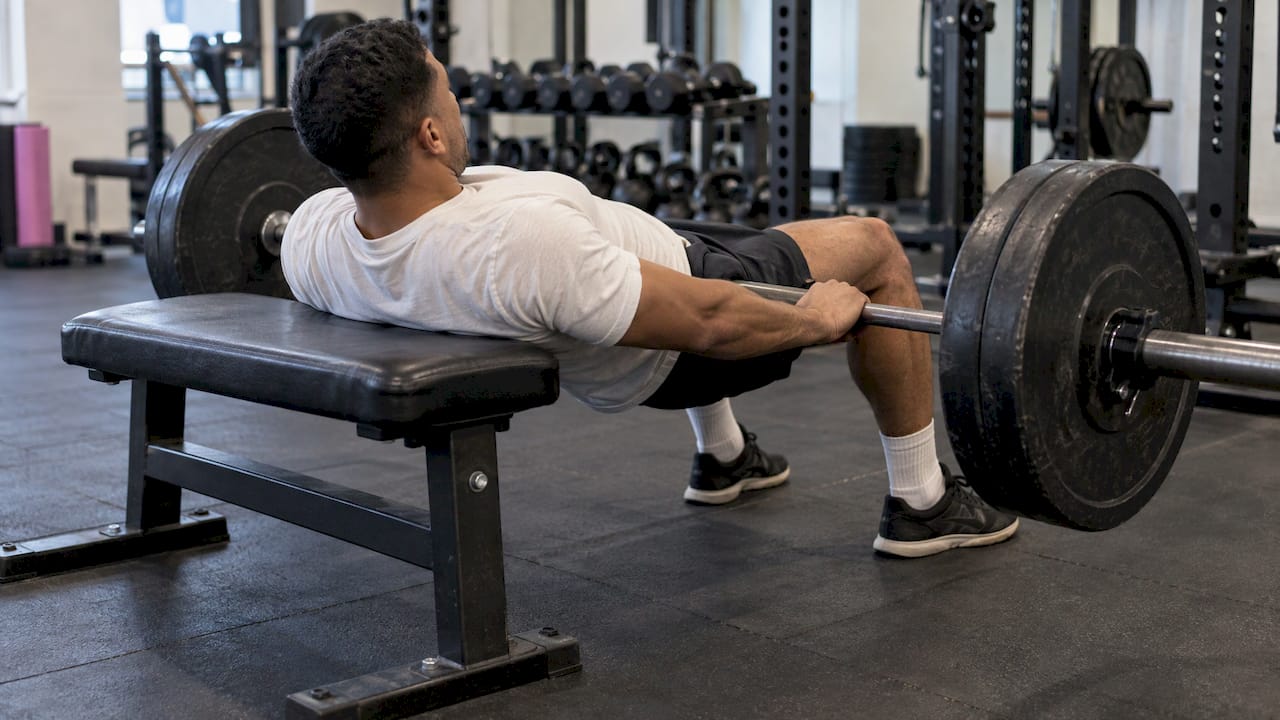
The hip thrust is a hinge pattern done from the floor with your upper back on a bench. It shines for glutes and is easy to load. Bench height matters a lot for the setup, and we break it down in our hip thrust bench guide.
Leg press
The leg press trains the quads, glutes and hamstrings with the trunk supported, so you can push hard without worrying about balance. It is also the exercise that varies most between gyms: sled angle, platform size and starting weight differ on almost every machine. We come back to that below.
How to perform them with sound technique
NASM's guidance on squats, drawn from the research it cites, boils down to a few checkpoints:
- Keep a neutral spine to avoid straining the lower back.
- Flex the hips and ankles equally as you descend.
- Let your knees track over your second and third toes without caving inward.
- Squat to a depth that is safe and effective for you. NASM notes that a hip crease below the knee gives greater glute and hamstring activation.
For deadlifts, NASM advises keeping the bar over the middle of your foot, the shins close to the bar, the lats engaged, the bar path straight, and squeezing the glutes at the top.
The most common faults are easy to spot. Knees collapsing inward usually means the load is too heavy for now. Heels lifting or the chest dropping often improves with a goblet or front squat. A bar that drifts away from your body on a deadlift costs you leverage.
One point on progression: an NSCA Strength & Conditioning Journal teaching progression moves from a plate squat to an overhead squat, then a front squat, and only then a back squat. Newer lifters can use that order as a map. If you are returning from an injury or feel pain in the knees, hips or lower back during any of these lifts, stop and see a physician or physical therapist before loading further.
How many compound exercises make a leg day
Less than you might think. SELF's trainer panel says an effective leg day can have just four or five exercises. One exercise per movement pattern can be enough if you keep applying progressive overload, which simply means doing a little more over time, whether that is weight, reps or sets. Healthline recommends beginners choose three to five exercises per leg workout, at three sets of 8 to 12 reps.
A simple template:
- A primary squat (back squat, front squat or leg press)
- A primary hinge (Romanian deadlift or deadlift)
- A single-leg movement (Bulgarian split squat, lunge or step-up)
- Optional: a hip thrust for extra glute work
- One or two accessories at the end
SELF's panel suggests beginners do 2 to 3 sets of 8 to 12 reps and rest about 60 seconds between sets. Heavy compounds usually warrant more rest once you progress, so use how you feel on the next set as your guide.
Balance knee-dominant and hip-dominant work
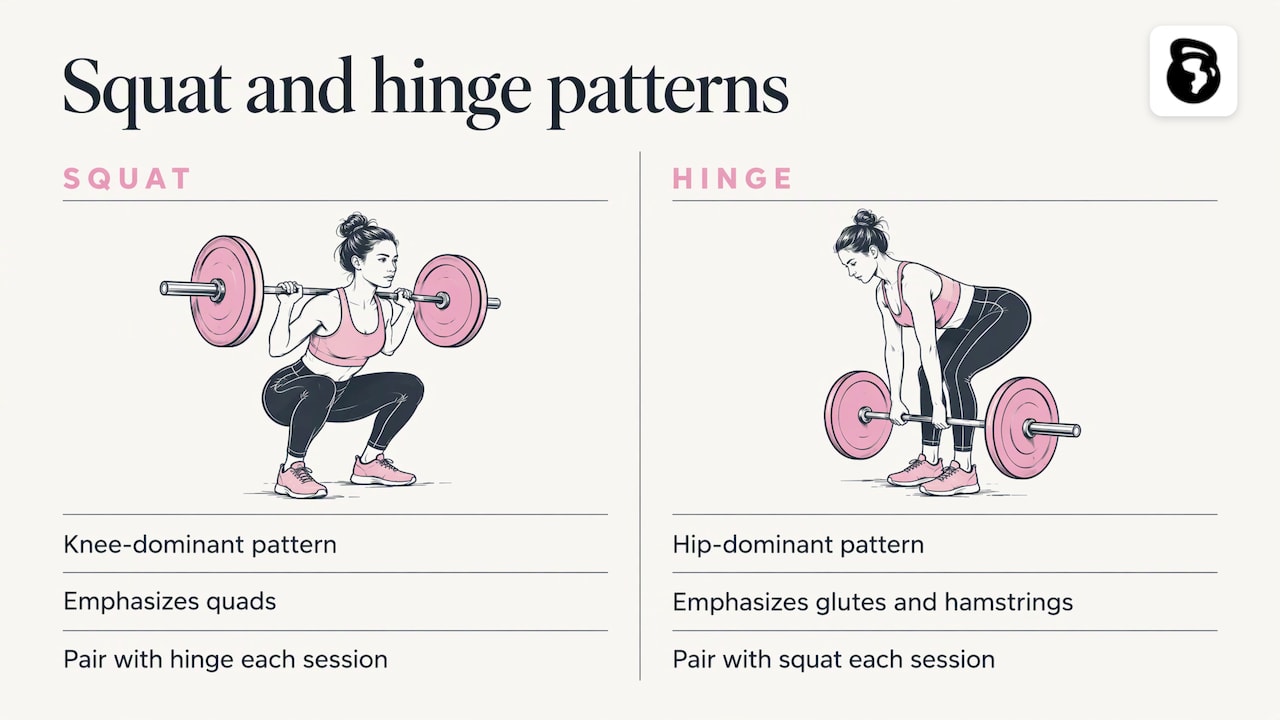
Every leg exercise leans on the quads (knee-dominant) or on the glutes and hamstrings (hip-dominant). Pair a squat with a hinge each session and you cover both without trying.
Finish with accessories
Compounds do most of the work, but a short finish rounds it out. The same trainer panel recommends adding accessory or isolation moves such as the leg curl, leg extension and calf raise to reach smaller muscles. For calves, our seated calf raise machine guide covers setup and tracking. Research on the hamstrings backs this up as well: Schoenfeld and colleagues note that single-joint hamstring exercises such as the leg curl produce notably higher hamstring activity than squats and leg presses, so a curl is a smart finisher after your squat and hinge.
The multi-gym problem: why your leg numbers get messy
Barbell lifts are fairly consistent: a 45-pound bar is a 45-pound bar. Machines are not. A leg press that loads 4 plates at one gym may start heavier, travel at a different angle or feel completely different at another. If you log "leg press, 360 lb" in one notebook, you quickly lose track of which machine, which foot position and which seat setting produced it.
This matters most for the leg exercises that depend on equipment: leg press, hack squat, leg curl, calf raise, and anything with a seat or pad you adjust. Progressive overload only works when you can compare this week's session with the last one on the same setup.
So a sound routine for lifters who train in more than one place looks like this:
- Keep one core routine (squat, hinge, single-leg, accessory) and adapt it per gym. A gym without a hack squat gets a front squat or Bulgarian split squat instead.
- Record seat positions, pin settings and foot placement for each machine, at each gym.
- Compare progress per gym, not across gyms. A number on a different machine is a different number.
- Log sessions even with no signal. You can finish the workout first and sync later.
Tracking compound leg lifts across gyms with Lightweight
Lightweight is built for gym-goers who train at multiple locations. You track workouts separately for each gym, with equipment setup notes and machine records saved per gym, and you can keep gym-specific versions of the same routine. Say your Romanian deadlift and leg press live in your usual gym's routine, while the gym near work swaps in a different machine. Both versions stay in the same app, each with its own history.
The free plan includes four routines, full workout history and charts, and both ChatGPT and Claude assistants for analysis and routine creation. Pro unlocks more, including custom statistics and routine scheduling. You can see exactly what is in each plan on the Lightweight features page.

If you train with a friend, Lightweight also lets you join their routine live, so a shared leg day stays in sync even when you are at different gyms. Gym Passport keeps a log of every gym you have trained at, with status points and permanent ranks, and leaderboards add a little competition to a heavy squat day. Compare options for logging your lifts in our overview of workout trackers for weightlifting, or start at the Lightweight home page.
A sample week of compound leg training
Here is one way to put it together for someone training legs twice a week, with the gym changes built in. Adjust loads so the last rep of each set is hard but clean.
Day A: squat emphasis
- Back squat or leg press: 3 sets of 8 to 12 reps
- Romanian deadlift: 3 sets of 8 to 12 reps
- Walking lunge: 2 to 3 sets per leg
- Standing or seated calf raise: 2 to 3 sets
Day B: hinge emphasis
- Deadlift or hip thrust: 3 sets of 8 to 12 reps
- Front squat or goblet squat: 3 sets
- Step-up: 2 to 3 sets per leg
- Leg curl: 2 to 3 sets
When a set feels easy at the top of the rep range, add a little weight next time. Keep notes on the setup of every machine so the jump is real, not a different seat position.
FAQ
What are the main compound leg exercises?
The core group is the squat (back, front, goblet), the hinge (deadlift, Romanian deadlift, hip thrust), the lunge and split squat, the step-up and the leg press. Most lifters do well with one exercise from each pattern across a week.
Are four exercises enough for leg day?
Yes. SELF's trainer panel says an effective leg day can have just four or five exercises, and Healthline suggests three to five for beginners. Choose one squat, one hinge and one single-leg move, then add an accessory.
How many reps and sets should I do?
Beginners can start with 2 to 3 sets of 8 to 12 reps, resting around 60 seconds, per SELF's trainers. Healthline suggests three sets of 8 to 12 reps. As you get stronger, you can use heavier loads for fewer reps on squats and hinges.
Do compound exercises train the calves and hamstrings enough?
They train both, but a short accessory finish adds focus. A calf raise and a leg curl are the usual choices, as the research on hamstring activity shows that curls load the hamstrings more directly than squats and leg presses.
Sources
- NASM: Squats and Deadlifts, Master the Fundamentals
- UNSW Newsroom: What are compound exercises and why are they good for you?
- SELF: The Best Leg Day Workout Plan, According to Top Trainers
- Healthline: Leg Workouts, The 15 Best Leg Exercises
- Fauth et al.: Hamstrings, quadriceps and gluteal muscle activation
- Neto et al.: Gluteus Maximus Activation during Common Strength and Hypertrophy Exercises
- NSCA Strength & Conditioning Journal: A Teaching Progression for Squatting Exercises
- Schoenfeld et al.: Calculating Set-Volume for the Limb Muscles